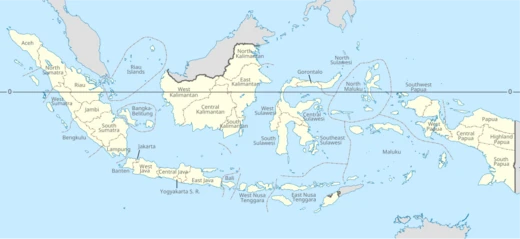
South Sumatra
Province of Indonesia, site of the ancient Srivijaya kingdom.

South Sumatra is a province of Indonesia, located in the southeast of the island of Sumatra. Despite its name, it is not the southernmost province on Sumatra, as Lampung lies to its south. The capital and largest city is Palembang, and the province covers territory historically administered by the Palembang Sultanate. It borders Jambi to the north, Bengkulu to the west, Lampung to the south, and has a maritime border with the Bangka Belitung Islands to the east. It is the largest province on the island of Sumatra, with an area of 86,771.92 km², slightly smaller than Portugal. The province had a population of 8,467,432 at the 2020 census, with an official mid-2025 estimate of 8,837,301. It is rich in natural resources such as petroleum, natural gas, and coal. The province is inhabited by many different Malay sub-ethnic groups, with Palembangese being the largest. Most speak the Palembang language, which is mutually intelligible to both Indonesian and local Palembang Malay.
- Capital
- Palembang
- Area
- 86,771.92 km²
- Population (2020 census)
- 8,467,432
- Population (mid-2025 estimate)
- 8,837,301
- Largest ethnic group
- Palembangese
- Major language
- Palembang language
- Historical significance
- Site of the Srivijaya kingdom
Lore & Background
South Sumatra has been settled by humans since the Palaeolithic era, evidenced by discoveries of Palaeolithic tools in the riverbed of Saling and Kikim rivers in Bungamas Village, Lahat Regency, and seventy-eight skeletons dating back 3,000–14,000 years, presumably of Austronesian and Austromelanesoid origins, excavated from Harimau Cave in Padang Bindu Village, Ogan Komering Ulu Regency. Around the 7th century AD, the ancient Buddhist kingdom of Srivijaya was established in an area that is now Palembang. The Kedukan Bukit inscription of 682 CE, reputed to be the oldest inscription written in Malay, records that Dapunta Hyang departed on the siddhayatra holy journey with 20,000 soldiers and 312 people on board with 1,312 soldiers on foot from Minanga Tamwan to Jambi and Palembang. Srivijaya controlled maritime trade routes in the Straits of Malacca, the Sunda Strait, the South China Sea, the Java Sea, and the Karimata Strait. In 1025, the empire was defeated by the Chola Empire of southern India, which captured the ruling king Sangrama Vijayottunggavarman. Srivijaya's capital eventually moved northward to Jambi. According to the Chinese Song dynasty book Zhu Fan Zhi, written around 1225 by Zhao Rugua, Srivijaya and Java (Kediri) were the two most powerful and richest kingdoms in the archipelago, with the western part under Srivijaya's rule.
Reader's Guide
South Sumatra's significance lies in its role as the heartland of the Srivijaya empire, a dominant maritime and Buddhist kingdom from the 7th to the 13th centuries. The empire controlled key trade routes, and its power was noted by Chinese, Arab, and Indian sources. In the 7th century, the Chinese noted that Malayu and Kedah were part of the Srivijaya empire. The Kota Kapur Inscription from 686 CE, found on Bangka island, states that the empire dominated the southern part of Sumatra, the islands of Bangka and Belitung, to Lampung, and that Emperor Sri Jayanasa launched a military expedition to punish the Bhumi Jawa kingdom. In 955 CE, Arab historian Al Masudi described Srivijaya as a large, rich kingdom with many soldiers, producing camphor, agarwood, cloves, sandalwood, nutmeg, cardamom, and gambier. The kingdom faced challenges from the Javanese Medang kingdom, which captured Palembang in 992 for a while, but Srivijaya forces repelled them. After the Chola defeat in 1025, Srivijaya's capital moved northward to Jambi, and its decline was also due to sedimentation of mud on the Musi River, which diminished merchant ships and tax revenue. The province's modern identity is shaped by its Malay heritage, with the Palembang language and diverse ethnic groups including Javanese, Sundanese, Minangkabau, and Chinese, mostly concentrated in urban areas as immigrants from other parts of Indonesia.
Did You Know?
- The Kedukan Bukit inscription of 682 CE is the oldest known inscription written in the Malay language.
- Seventy-eight skeletons dating back 3,000–14,000 years, of Austronesian and Austromelanesoid origins, were excavated from Harimau Cave in Ogan Komering Ulu Regency.
- In 1025, the Chola Empire of southern India defeated Srivijaya and captured its king, Sangrama Vijayottunggavarman.
- The Chinese Song dynasty book Zhu Fan Zhi (c. 1225) described Srivijaya as one of the two most powerful and richest kingdoms in the Southeast Asian archipelago, alongside Java (Kediri).
- Sedimentation of mud on the Musi River contributed to Srivijaya's decline by reducing merchant ship access and tax revenue.
Frequently Asked Questions
Where exactly is South Sumatra on the island of Sumatra, and why is the name confusing?
South Sumatra sits in the southeastern part of Sumatra, but it is not the island's southernmost province—Lampung stretches further south. The name simply reflects its position relative to the northern Sumatran provinces rather than marking the extreme tip of the landmass.
What city serves as South Sumatra's capital, and what is its role?
Palembang is both the provincial capital and the largest city in South Sumatra. It has long functioned as the administrative and commercial hub for the entire region, rooted in the legacy of the old Palembang Sultanate.
What ancient kingdom is South Sumatra most famously linked to?
The province is the historical heartland of the Srivijaya maritime empire, one of Southeast Asia's most influential pre-modern states. Much of the territory South Sumatra now covers was once under Srivijayan or later Palembang Sultanate administration.
How large is South Sumatra, and how does that compare to other regions?
At roughly 86,772 square kilometres, South Sumatra is the largest province on Sumatra, edging out its neighbours in sheer land area. Its size is just a touch smaller than the country of Portugal, making it a surprisingly vast stretch of Indonesian territory.
What natural resources make South Sumatra economically significant?
The province is rich in petroleum deposits, natural gas fields, and coal reserves, which have long underpinned its economy. These resources, combined with its large population of over eight million people, give South Sumatra considerable weight in Indonesia's energy and industrial landscape.
More in Provinces Of Indonesia 1-24
Related in Provinces Of Indonesia
Links follow this subject's own source article.
Elsewhere in the Provinces Of Indonesia universe
Spotted an error? Know more?
This is a living reference — every entry is fact-audited, and reader corrections feed straight into our audit queue. Suggest an edit · See this site's audit record