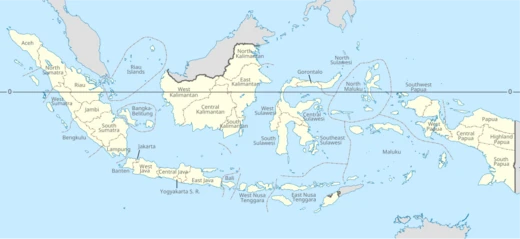
Southeast Sulawesi
Indonesian province on Sulawesi's southeastern peninsula, historically the Buton Sultanate.

Twotwofourtysix · CC BY-SA 4.0
Southeast Sulawesi (Indonesian: Sulawesi Tenggara) is a province on the island of Sulawesi, forming the southeastern peninsula of that island, together with a number of substantial offshore islands such as Buton, Muna, Kabaena, and Wawonii, together with many smaller islands. It is bordered by South Sulawesi and Central Sulawesi to the north, sharing a maritime border with Maluku and North Maluku to the east and East Nusa Tenggara to the south, as well a very narrow maritime border with East Timor to the south. The capital is the city of Kendari, on the east coast of the peninsula. The province has no highway road connecting to the rest of the island, and the primary transportation link is a ferry across the Bone Gulf between Watampone (Bone) in South Sulawesi and the port of Kolaka in Southeast Sulawesi.
- Capital
- Kendari
- Population (2020 Census)
- 2,624,875
- Population (mid-2025 estimate)
- 2,836,740
- Major Religion
- Islam (96.2%)
- Number of Regencies and Cities
- 15 regencies and 2 cities
- Primary Transportation Link
- Ferry across Bone Gulf
Verified Timeline
Lore & Background
From the seventeenth century until the early twentieth century, the region was the site of the Buton Sultanate (Butung). The two major mountain ranges in Southeast Sulawesi are the Tanggeasinua Range and the Mekongga Range. The major rivers are the Lalinda, the Lasolo, and the Sampara. The population of the province was 2,232,586 at the 2010 decennial census (1,120,225 males, and 1,110,344 females), increasing to 2,624,875 at the 2020 Census. The official estimate as at mid 2025 was 2,836,740. Konawe Selatan, Konawe, Kolaka and Muna are the four most populous regencies. A third of the population is centered on Buton and Muna islands off the south coast of Sulawesi, and another 15% live in and around Kendari.
Reader's Guide
Southeast Sulawesi Province is divided into fifteen regencies (including the five new regencies established in 2013 and 2014) and two autonomous cities. As at 1995, there were just four regencies within the province - Buton, Kolaka, Konawe and Muna. On 3 August, the city of Kendari was created from part of Konawe Regency, and on 21 June 2001 the city of Bau-Bau was created from part of Buton Regency. On 25 February 2003, South Konawe Regency was created from part of Konawe Regency. On 18 December 2003, three new regencies were created - Bombana Regency and Wakatobi Regency from parts of Buton Regency, and North Kolaka Regency from part of Kolaka Regency. On 2 January 2007, two new regencies were created - North Konawe Regency from part of Konawe Regency, and North Buton Regency from part of Muna Regency. In 2013 the Indonesian Government enacted the creation of 11 new Regencies and Municipalities, including Konawe Islands Regency (enacted by Act No.8 of 2013, on 11 January 2013) and East Kolaka Regency (enacted by Act No.11 of 2013, on 11 May 2013). Subsequently, on 24 June 2014, the Indonesian Parliament agreed to create three more new regencies: South Buton Regency, Central Buton Regency, and West Muna Regency (all enacted by Act No.16 of 2014, on 23 July 2014). The province now forms one of Indonesia's 84 national electoral districts to elect members to the People's Representative Council. The Southeast Sulawesi Electoral District consists of all of the 15 regencies in the province, together with the cities of Kendari and Bau-Bau, and elects 6 members to the People's Representative Council.
Did You Know?
- The province has no highway road connecting to the rest of Sulawesi island.
- From the seventeenth century until the early twentieth century, the region was the site of the Buton Sultanate (Butung).
- A third of the population is centered on Buton and Muna islands off the south coast of Sulawesi.
- The province expanded from four regencies in 1995 to fifteen regencies and two cities by 2014.
- The Southeast Sulawesi Electoral District elects 6 members to the People's Representative Council.
Geography & Maritime Isolation
Southeast Sulawesi occupies the southeastern peninsula of the great island of Sulawesi, stretching its territory across a mainland shore and a constellation of substantial offshore islands including Buton, Muna, Kabaena, and Wawonii (historically known as Wowoni), along with numerous smaller islets. The province shares land borders with South Sulawesi and Central Sulawesi to the north, while its maritime boundaries extend eastward toward Maluku and North Maluku, southward toward East Nusa Tenggara, and even include a remarkably narrow sea border with East Timor. The provincial capital, Kendari, sits along the east coast of the peninsula. Perhaps the most striking geographic fact about Sultra is its complete lack of a highway road linking it to the rest of Sulawesi. The principal overland connection is a ferry crossing the Bone Gulf, running between Watampone in South Sulawesi's Bone region and the port of Kolaka. Two major mountain ranges—the Tanggeasinua and the Mekongga—dominate the interior terrain, while the Lalinda, Lasolo, and Sampara rivers carve through the landscape.
The Buton Sultanate & Ethnic Mosaic
For roughly three centuries, from the seventeenth century through the early twentieth, the region that is now Southeast Sulawesi served as the heartland of the Buton Sultanate, known locally as Butung. This long-standing political entity shaped the cultural and social fabric of the peninsula and its surrounding islands in ways that persist to this day. The province today is home to a remarkable diversity of ethnic communities. The Buton group encompasses the Wolio, Lasalimu, Kumbewaha, and Cia-cia peoples, while the Muna group includes the Busoa, Kaimbulawa, Liabuku, Pancana, and Kioko. The Wakatobi islands are home to the Tukangbesi and Bonerate, and the mainland hosts the Tolaki, Culambacu, Kalisusu (with their Taloki and Koroni subgroups), Moronene, and Wawonii communities. This layered ethnic landscape, rooted in centuries of sultanate governance and island-to-island interaction, gives Sultra a cultural depth that distinguishes it from other parts of the Indonesian archipelago.
Administrative Fragmentation & Growth
When Southeast Sulawesi was first formally organized as a province in 1995, it contained only four regencies: Buton, Kolaka, Konawe, and Muna. Since then, the province has undergone a dramatic administrative expansion. Kendari was carved out of Konawe to become an autonomous city, followed by Bau-Bau's creation from Buton in 2001. The early 2000s saw the establishment of South Konawe, Bombana, Wakatobi, and North Kolaka. In 2007, North Konawe and North Buton were added. A wave of further division in 2013 produced Konawe Islands Regency and East Kolaka Regency, both split from Konawe. Then in 2014, South Buton, Central Buton, and West Muna were established. The result is a province now comprising fifteen regencies and two autonomous cities. Notably, Central Buton Regency actually comprises the southern portion of Muna Island and a small part of Kabaena, despite its name. The province also serves as one of Indonesia's eighty-four national electoral districts, sending six representatives to the People's Representative Council.
Population & Religious Landscape
Southeast Sulawesi's population has grown steadily over the past decade and a half. The 2010 decennial census recorded 2,232,586 residents, split almost evenly between 1,120,225 males and 1,110,344 females. By the 2020 Census, that figure had climbed to 2,624,875, and the official mid-2025 estimate places the population at 2,836,740. The four most populous regencies are Konawe Selatan, Konawe, Kolaka, and Muna. Population distribution is notably uneven: roughly one-third of all residents live on Buton and Muna islands off the south coast, while another fifteen percent are concentrated in and around the capital city of Kendari. Religiously, the province is overwhelmingly Muslim, with Islam accounting for 96.2 percent of the population. The 2021 estimates place the Muslim community at approximately 2,560,000. Smaller religious communities include around 50,780 Hindus, 44,870 Protestants, 16,180 Roman Catholics, 1,610 Buddhists, 113 Confucians, and 63 adherents of folk religions.
Gallery
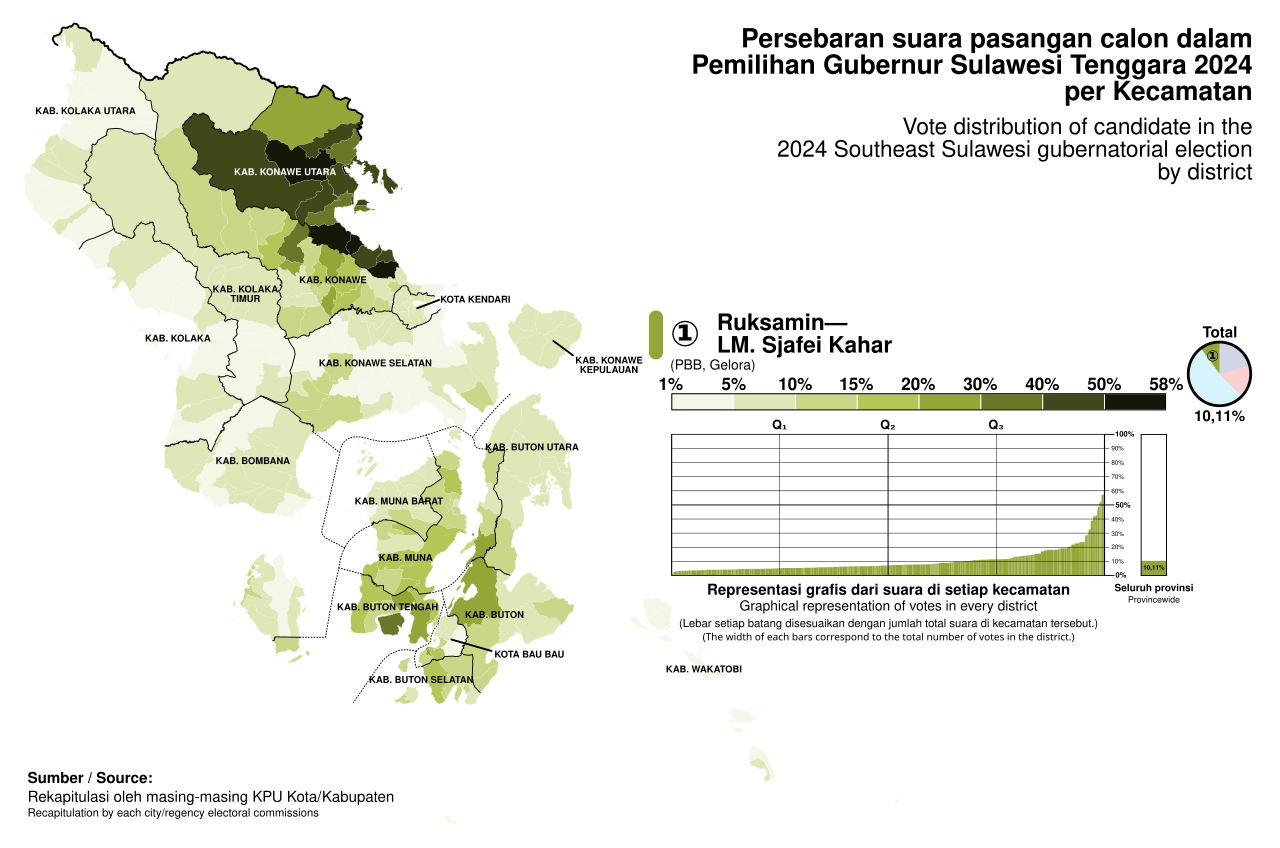
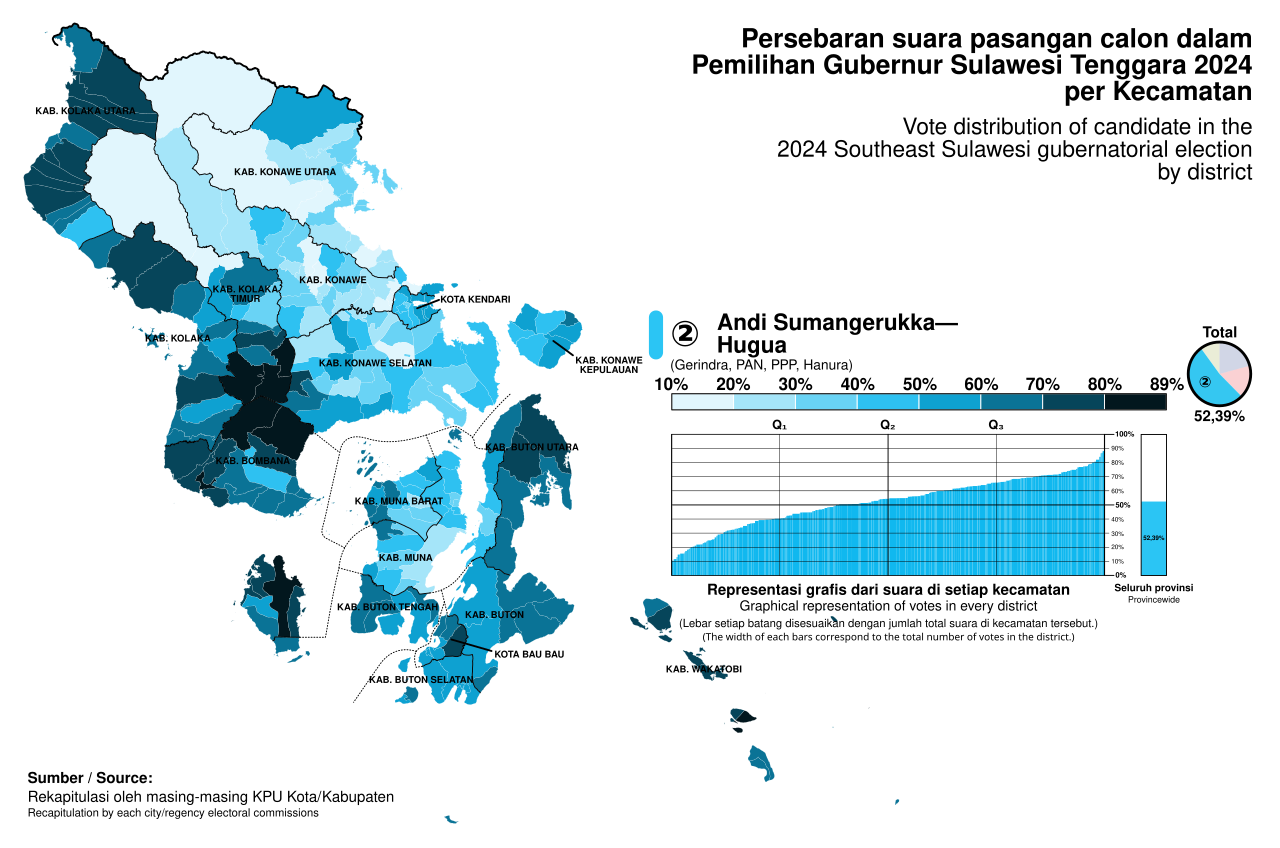
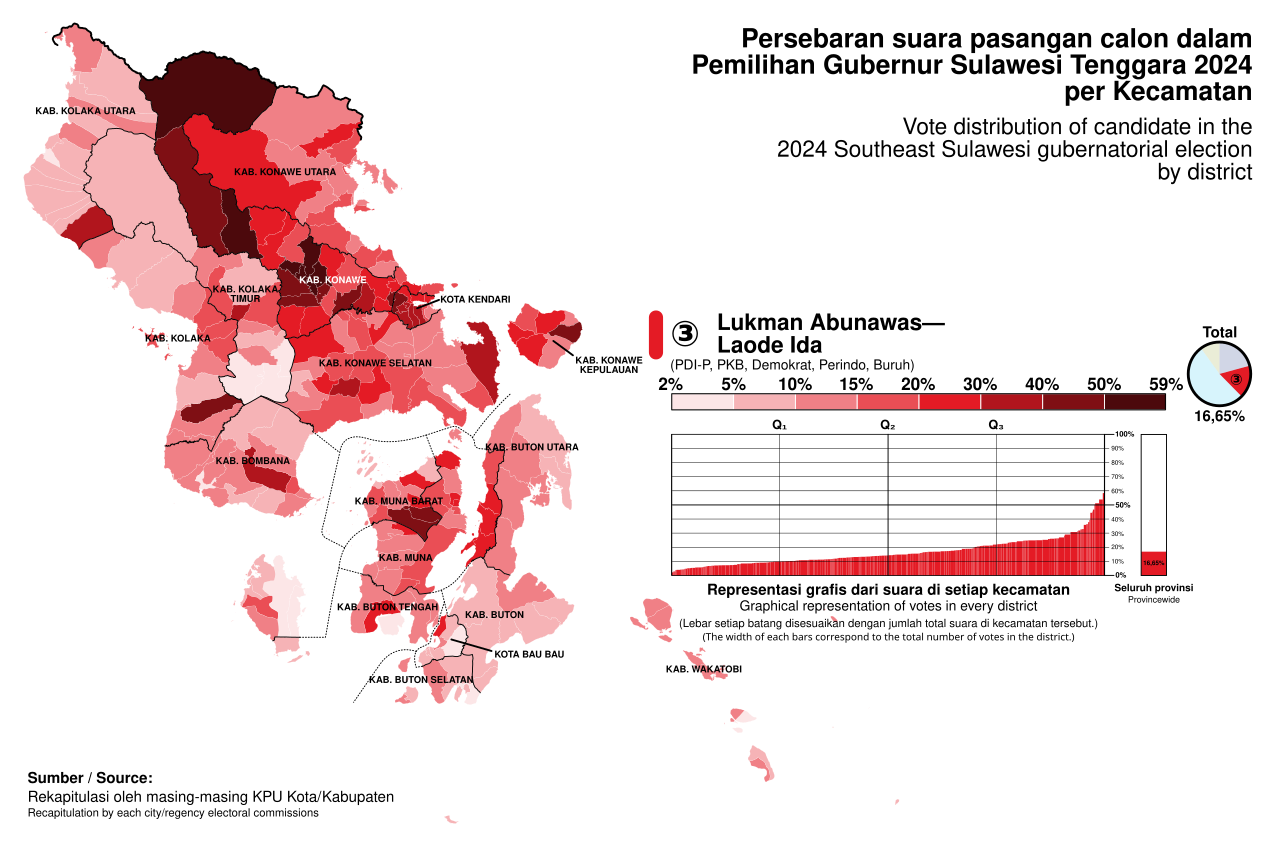
Frequently Asked Questions
Who is Southeast Sulawesi?
Southeast Sulawesi (Sulawesi Tenggara) is an Indonesian province occupying the southeastern arm of the island of Sulawesi, with its seat in Kendari. Its territory stretches across the peninsula and out to offshore islands like Buton, Muna, Kabaena, and Wawonii.
What are Southeast Sulawesi's powers/role?
The province's defining geographic trait is its isolation by road—there is no highway linking it to the rest of Sulawesi. Overland travelers must instead take a ferry across the Bone Gulf from Watampone in South Sulawesi down to the port of Kolaka.
How does Southeast Sulawesi's story end?
As a living province rather than a finished narrative, Southeast Sulawesi continues to grow, with a mid-2025 population estimate of roughly 2.84 million spread across 15 regencies and 2 cities. Islam is the dominant faith, practiced by over 96 percent of residents.
Why is Southeast Sulawesi important?
The region served as the homeland of the Buton Sultanate, a maritime power that flourished from the seventeenth century into the early twentieth century. Its position at the tip of Sulawesi's southeastern peninsula also makes it a key node in eastern Indonesian sea routes.
What is Southeast Sulawesi's backstory/origin?
Long before it became a modern administrative province, the area was the seat of the Buton Sultanate, one of the last major Islamic sultanates in eastern Indonesia. That sultanate endured from the 1600s until the early 1900s, shaping the cultural and political identity of the region.
More in Provinces Of Indonesia 25-26
Related in Provinces Of Indonesia
Links follow this subject's own source article.
Elsewhere in the Provinces Of Indonesia universe
Spotted an error? Know more?
This is a living reference — every entry is fact-audited, and reader corrections feed straight into our audit queue. Suggest an edit · See this site's audit record