Central Kalimantan
Largest Indonesian province by area, home to Dayak peoples.

via Wikipedia: Central Kalimantan · see source
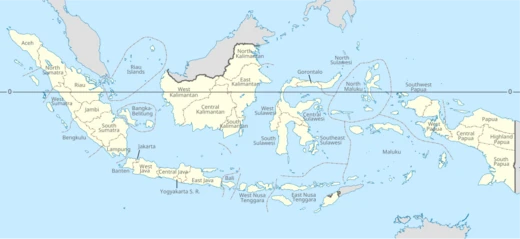
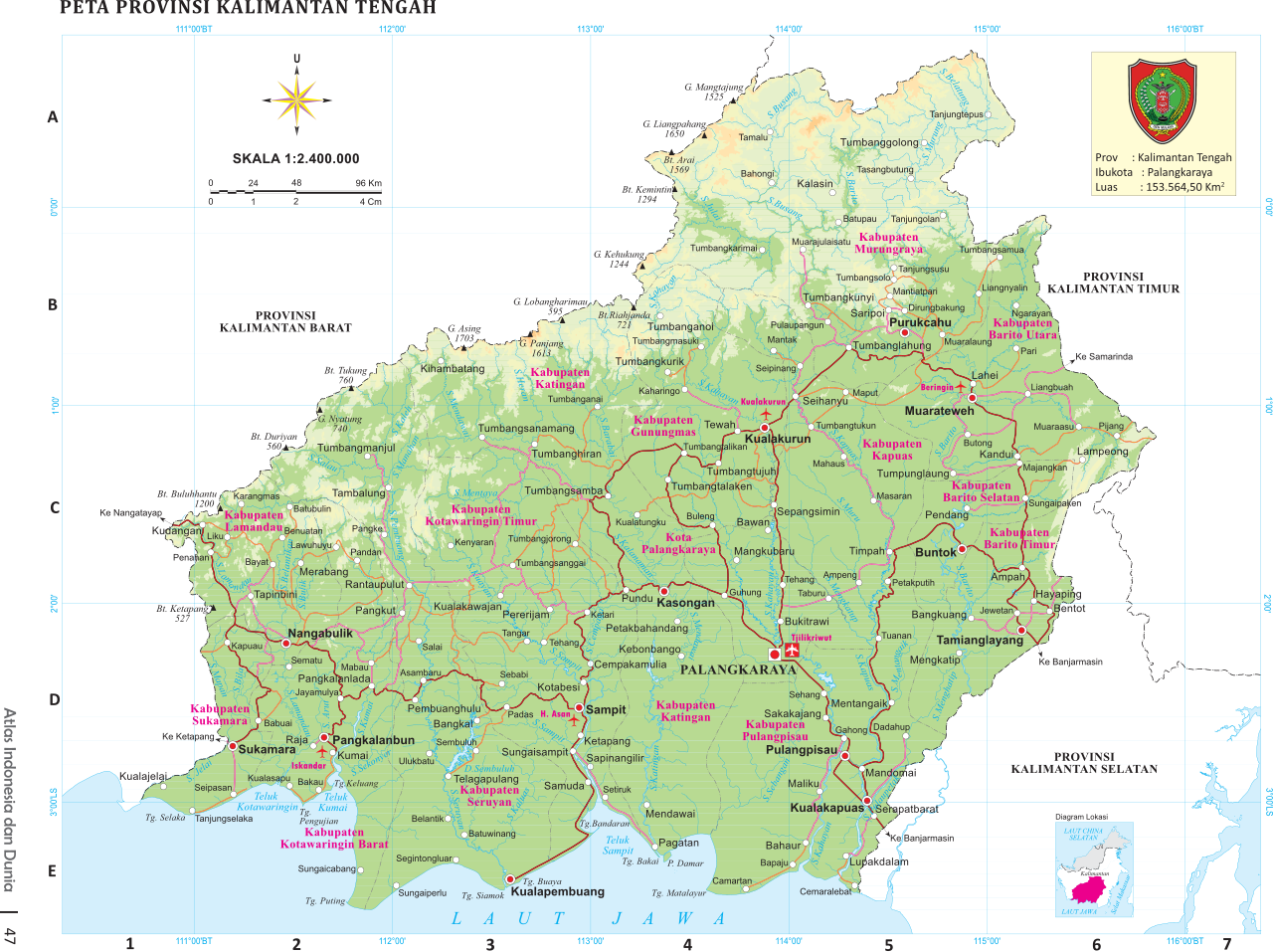
Central Kalimantan (Indonesian: Kalimantan Tengah) is a province of Indonesia, one of five provinces in Kalimantan, the Indonesian part of Borneo. It is the largest province in Indonesia by area since 2022, bordered by West Kalimantan to the west, South Kalimantan and East Kalimantan to the east, the Java Sea to the south, and separated narrowly from North Kalimantan and Malaysia by East Kalimantan's Mahakam Ulu Regency. Its provincial capital is Palangka Raya. The 2020 Census showed a total population of almost 2.67 million, while the official estimate as at mid 2025 was 2,844,992. More than is the case in other provinces on Kalimantan, Central Kalimantan is populated by the Dayaks, the indigenous inhabitants of Borneo.
- Capital
- Palangka Raya
- Area
- 153,430.36 km²
- Population (mid-2025 estimate)
- 2,844,992
- Population density
- 18.54 people/km²
- Largest religious group
- Islam (over 74%)
- Major ethnic groups
- Dayak (Ngaju, Ot Danum, Dusun Ma'anyan Ot Siang)
- Established
- 23 May 1957
Verified Timeline
Lore & Background
Since the eighteenth century the central region of Kalimantan and its Dayak inhabitants were ruled by the Muslim Sultanate of Banjar. Following Indonesian independence after World War II, Dayak tribes demanded a province separate from South Kalimantan province. In 1957 South Kalimantan was divided to provide the Dayak population with greater autonomy from the Muslim population in the province. The change was approved by the Indonesian Government on 23 May 1957 under Presidential Law No. 10 Year 1957, which declared Central Kalimantan the seventeenth province of Indonesia. President Sukarno appointed the Dayak-born national hero Tjilik Riwut as the first Governor and designated Palangkaraya as the provincial capital. The province's geography includes the Schwaner Mountains stretching from the north-east to the south-west, 80% of which is covered in dense forest, peatland swamps, mangroves, rivers and traditional agriculture land. The southern lowlands are dominated by peatland swamps that intersect with many rivers. Sabangau National Park is a protected peatland area internationally acknowledged as sanctuary for the endangered Orangutan. Recently the peat swamp forests have been damaged by the Mega Rice Project, which unsuccessfully sought to turn large areas into rice paddies. Central Kalimantan comprises approximately ten different ecological regions; the peat ecoregion covers 26% of the total area and the fluvial plain ecoregion covers 21%. Due to its high concentration of peat, the province is prone to drought and peat fires during the dry season and inundation during the rainy season within each episodes of the ENSO and the IOD, worsened by massive deforestation and climate change. The province is home to endemic floras and faunas like orangutans, proboscis monkeys, hornbill birds, rattan, and Bornean iron wood.
Reader's Guide
Central Kalimantan holds significance as the largest province in Indonesia by area since 2022, with a size of 153,430.36 km², about 1.5 times the size of the island of Java. It was established on 23 May 1957 to provide the Dayak population with greater autonomy from the Muslim population in South Kalimantan. The province's economy relies heavily on its rivers for transportation and settlement, with relatively undeveloped infrastructure. Major rivers include the Barito (900 km), Kapuas (600 km), Kahayan (600 km), and Katingan (600 km), all flowing southwards from the Schwaner Mountains to the Java Sea. Ecologically, Central Kalimantan is critical for its extensive peatlands, which cover 26% of the area and are internationally important for biodiversity—hosting endangered species like orangutans—but are threatened by the failed Mega Rice Project, deforestation, and climate change. The province's traditional governing system is led by Damang, with 67 traditional law areas known as Kedamangan, intended to culturally recognize and preserve the customs of the Dayak tribes. Demographically, the largest religious group is Islam with more than 74% of the total population, followed by Christianity with more than 19%, and the rest adhere to Kaharingan, Hinduism, and Buddhism with more than 5%. The population growth rate was almost 3.0% per annum between 1990 and 2000, one of the highest provincial growth rates in Indonesia during that time.
Did You Know?
- Central Kalimantan became the largest province in Indonesia by area in 2022, after Papua Province was partitioned.
- The province's population growth rate was almost 3.0% per annum between 1990 and 2000, one of the highest in Indonesia during that time.
- Sabangau National Park is a protected peatland area internationally acknowledged as a sanctuary for the endangered Orangutan.
- The province has 67 traditional law areas known as Kedamangan, each headed by a Damang, to preserve Dayak customs.
- The Mega Rice Project unsuccessfully sought to turn large areas of peat swamp forests into rice paddies, damaging the ecosystem.
The Name and Its Roots
The name Kalimantan carries a story that stretches back to ancient Sanskrit. The word derives from Kalamanthana, a phrase that translates roughly to 'burning weather island' or 'very hot island,' a direct nod to the scorching, humid tropical conditions that define the region. Breaking it down, the root kal[a] speaks to time, season, or period, while manthan[a] evokes the imagery of boiling, churning, or burning heat. Long before European maps took shape, the native peoples of Indonesian Borneo already called their home Pulu K'lemantan. When the sixteenth-century Portuguese explorer Jorge de Menezes made contact with these communities, that native name was what he encountered. Yet it was the Bruneian Sultanate in the island's northern reaches that caught European attention during the Age of Exploration, and from that encounter the English name Borneo was born. Within Indonesia itself, however, the entire island is simply known as Kalimantan. In the early twentieth century, British colonist Charles Hose even coined the term 'Klemantan people' to describe the island's inhabitants, a label that has since fallen out of use given the rich tapestry of ethnic groups that call the region home.
Administrative Transformation
Central Kalimantan's existence as a distinct administrative unit is the product of a gradual political reshaping that unfolded over nearly seven decades. When Indonesia first asserted its sovereignty in 1945, the entire Indonesian portion of Borneo was governed as a single province. That arrangement lasted until 1956, when the territory was divided into three separate provinces: East Kalimantan, South Kalimantan, and West Kalimantan. The following year, in 1957, a further subdivision took place. The province of Central Kalimantan was carved out of the existing South Kalimantan, giving the region its own identity and governance structure. For the next fifty-five years, Kalimantan remained a four-province configuration. Then, on 25 October 2012, East Kalimantan shed a portion of its territory to create the province of North Kalimantan, bringing the total to five. Each of these divisions reflected shifting political, economic, and demographic realities, and Central Kalimantan's 1957 creation marked a pivotal moment in how the island's central heartland came to be administered independently from its southern neighbor.
The Capital City Dream
In 2019, President Joko Widodo put forward a proposal that would reshape the political geography of the entire nation: relocating Indonesia's capital to the island of Kalimantan. The idea gained legislative traction when the People's Consultative Assembly approved the Law on State Capital in January 2022, setting the stage for the creation of Nusantara, a planned city to be carved out of East Kalimantan. A government official indicated that construction was expected to be fully complete by 2045, a timeline that underscores the sheer scale of the undertaking. The project has not, however, progressed without symbolic milestones and setbacks. The still-unfinished capital officially celebrated Indonesian Independence Day for the first time, a gesture of national pride amid ongoing construction. The city was scheduled to be formally inaugurated as the capital on 17 August 2024, a date aligned with the anniversary of independence. Yet the move ultimately did not take place, as delays in construction forced the government to postpone the transition, leaving Nusantara in a state of ambitious incompletion.
Scale and Environmental Stakes
The sheer scale of Kalimantan is difficult to overstate. The Indonesian portion of Borneo encompasses 534,698.27 square kilometres, roughly 206,448 square miles, and accounts for 73 percent of the island's total area. The remaining territory is divided between Brunei, home to approximately 460,345 people as of 2020, and East Malaysia, whose states of Sabah and Sarawak along with the federal territory of Labuan together housed nearly six million residents that same year. The Indonesian side of the island is home to a population that swelled from 13,772,543 at the 2010 Census to 23,053,723 by 2020, a remarkable demographic surge in a single decade. Yet this growth has come at a significant ecological cost. Academics have repeatedly described the widespread deforestation and other forms of environmental destruction across Kalimantan and other parts of Indonesia as an ecocide, a term that captures the severity of habitat loss in the region. The tension between rapid population expansion and the preservation of the island's natural heritage remains one of its most pressing challenges.
Gallery
Frequently Asked Questions
What is Central Kalimantan?
Central Kalimantan (Kalimantan Tengah) is one of five Indonesian provinces situated on the island of Borneo, and since 2022 it holds the title of the country's largest province by land area at over 153,000 square kilometres. Its administrative capital is the city of Palangka Raya.
Why was Central Kalimantan created as a separate province?
The province was established in 1957 to give the indigenous Dayak population greater political autonomy, separating them administratively from the Muslim-majority community that had dominated South Kalimantan.
Who are the major ethnic groups in Central Kalimantan?
The Dayak peoples form the cultural backbone of the province, with prominent subgroups including the Ngaju, Ot Danum, and Dusun Ma'anyan Ot Siang. Despite this deep Dayak heritage, Islam is now the largest religion, practiced by over 74% of residents.
How populated is Central Kalimantan relative to its size?
With a mid-2025 estimated population of roughly 2.84 million people spread across 153,430 square kilometres, the province works out to only about 18.5 people per square kilometre, making it one of Indonesia's most sparsely settled regions.
What makes Central Kalimantan significant in Indonesian geography?
Since 2022 it has been the largest province in all of Indonesia by land area, covering a vast stretch of Borneo's interior. Its combination of enormous territory, very low population density, and deep Dayak cultural roots sets it apart from every other province.
More in Provinces Of Indonesia 1-24
Related in Provinces Of Indonesia
Links follow this subject's own source article.
Elsewhere in the Provinces Of Indonesia universe
Spotted an error? Know more?
This is a living reference — every entry is fact-audited, and reader corrections feed straight into our audit queue. Suggest an edit · See this site's audit record